Ove’s death and arrangements for his estate
A Man Called OveOve’s death and arrangements for his estate close his story by bringing private grief, practical care, and the community he has gathered around him into the same scene. On a snowy November morning, Parvaneh discovers him apparently at rest, with The Cat at his side. The envelope he leaves for her records the life he has built into documents and assigns his possessions and money with the same blunt care with which he once attended to houses, cars, and neighbors. His funeral then draws a crowd far larger than he wanted, making visible the attachments he rarely expressed aloud.
The last morning
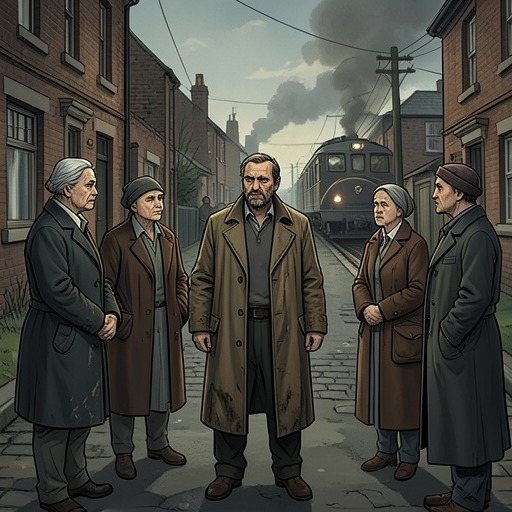
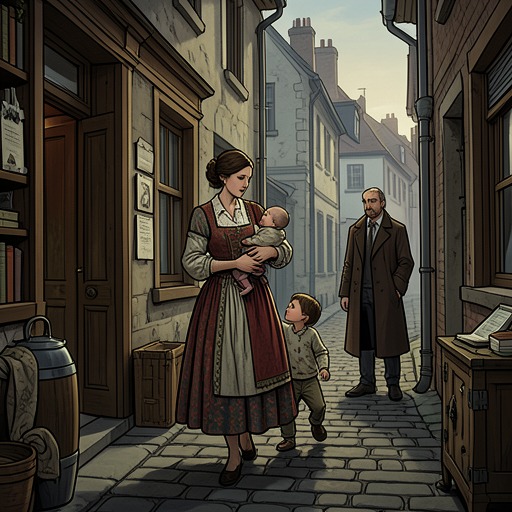
The discovery comes almost four years after Parvaneh and Patrick backed their trailer into Ove’s mailbox. By then the seasons have passed through summer, autumn, and winter, and the routines around the houses have become part of a shared life. Parvaneh’s daughters have celebrated birthdays; Ove has gone with one to school, learned from her how to put smileys into text messages, and made her promise not to tell Patrick he owns a cell phone. Their little brother scatters toys in Ove’s kitchen, and Ove builds a pool for him, objecting to the less imposing name others give it. These details establish not an abstract neighborhood but an accumulating set of ordinary responsibilities and intimacies around Ove.
One icy Sunday, at quarter past eight, Parvaneh notices that the snow outside Ove’s house has not been cleared. The omission is alarming because it interrupts a dependable part of his day. She crosses the road in her dressing gown and slippers, uses the spare key he has given her, and hurries upstairs to his bedroom. Ove looks as though he is sleeping deeply, his face unusually peaceful. The Cat lies beside him, its head resting in the palm of his hand. When the cat sees Parvaneh, it slowly rises and climbs into her lap. She remains beside Ove, stroking his hair, until the ambulance crew explains that they must take his body away. Her farewell is a private message to Sonja, followed by her taking the large envelope marked for her from the bedside table.
The life in the envelope
The papers inside the envelope make Ove’s preparation tangible. They include certificates and documents, the original plans for the house, instructions for the video player, the Saab’s service booklet, bank and insurance information, and the telephone number of a lawyer handling his affairs. This orderly file is a final expression of his practical habits: a whole life set out so that someone else will not have to guess what to do next. The house plans also connect the inheritance to a place he once chose to save. When the council sought to acquire his childhood home for demolition, he refused to sell and decided instead to repair it; now Parvaneh has the keys and responsibility for what remains there.
Ove’s letter gives specific instructions. Adrian is to receive the Saab, while Parvaneh is to handle everything else. He notes that The Cat eats tuna twice a day and does not like relieving itself in other people’s houses, turning even a large inheritance into a reminder of daily care. He identifies an account holding 11,563,013 kronor and 67 öre, money from Sonja’s father, who had owned shares. Ove explains that he and Sonja had never known what to do with it. He directs that Parvaneh’s children each receive a million kronor when they turn eighteen, with the same provision for Jimmy’s daughter, and leaves the remainder to Parvaneh. A final approving note, and the smiley he has learned from Nasanin, soften the otherwise practical instructions without disguising his characteristic bluntness.
Grief carried forward
Ove’s arrangements follow a life in which his attachment to Sonja remains present rather than resolved. Six months after her death, he still checks the radiators throughout the house twice daily, as if she might have returned and secretly turned up the heat. In another scene, a photograph of the couple on a Spanish bus tour holds him for an hour: he remembers Sonja folding her index finger into his palm while they held hands, and the security that gesture gave him. His brief words at her grave, repeated across the story, make absence a continuing relationship. He brushes snow from the stone, replenishes the flowers, and runs his hand over it again and again. These acts give the final reference to Sonja at Ove’s bedside more than ceremonial force: even in the letter and the arrangements for the living, his bond with her remains part of his way of understanding the world.
The house, too, carries care in material form. After Sonja’s accident, Ove rebuilt the kitchen himself, lowering its stove and counters to suit her; the marks of her movement remain visible there. His home is thus both the setting of his solitary routines and a record of the work he undertook for her. The envelope’s plans and keys pass that history to Parvaneh, who has become someone Ove trusts with what he cannot oversee himself. His directions about the cat, the money, and the neighborhood extend that trust into distinct forms of responsibility.
The funeral and its reversal
Ove’s written instructions are unequivocal: he wants no ceremony or fuss, only burial beside Sonja. Yet more than three hundred people attend his funeral. When Patrick and Parvaneh arrive with the girls, people are standing along the walls and aisles, each holding a candle engraved with Sonja’s Fund. Parvaneh has decided that most of Ove’s money will support a charity fund for orphaned children. The candles make the disposition of the estate visible as something more than paperwork: resources Ove and Sonja had not known how to use become support for children without parents.
The crowd directly contradicts Ove’s stated preference, and the contradiction is affectionate rather than solemnly corrective. Patrick nudges Parvaneh and observes that Ove would have hated the turnout; she laughs because he would have. That laughter preserves Ove’s resistance to ceremony even as the gathering testifies to the reach of his life. The death is therefore not presented as a change in his character but as the moment when his concealed attachments become legible to others: in the spare key, the carefully assigned money, the cat in his hand, and the hundreds who come to say goodbye.